Saturday, September 22, 2018

Learning from Fieldwork


Introduction.
As a student of social work, it’s necessary to spend time in the field to relate learnings from class in the field. Context is much important and therefore developing epistemology through field helps to understand different contextual realities. A theory does not make contexts, it's the context which makes theory and as a student of Dalit and Tribal social work it's necessary to focus on the context and not only on theory. Context is equally as important as theory.
For the student of Dalit & Tribal social work, the clarity of perspective is most important, without clarity of perspective the complex caste and tribe realities will be difficult to understand, therefore the perspective from below is needed to understand Dalit realities and perspective from within is to understand tribal realities. Without perspective, the knowledge will be not that rich and could not make us understand the realities better. Going into the field with perspective from above, will not generate epistemology which empowers the communities, not just community but it will not help the social worker to learn and understand the reality. So, therefore, perspective is very important.
The student has invested enough time in understanding the importance of context, the perspective from below and perspective from within and critical thinking before going into the field.
The student has placed in Udaipur to study the effectiveness of DMFT( District mineral foundation trust) so the target population was people who are directly or indirectly affected by mines, the student has been given an interview schedule by which he conducted interviews and did case studies to get rich qualitative data as so much quantitative data is already there. District Mineral Foundation (DMF) is a trust set up as a non-profit body, in those districts affected by the mining works, to work for the interest and benefit of persons and areas affected by mining-related operations. It is funded through the contributions from miners. Its manner of operation comes under the jurisdiction of the relevant State Government. Setting up of District Mineral Foundations (DMFs) in all districts in the country affected by mining-related operations was mandated through the Mines and Minerals (Development & Regulation) Amendment Act, (MMDRA) 2015.  On 16 September 2015, Central Government issued a notification directing states to set up DMF. The Central Government notified on 17 September 2015, the rates of contribution payable by miners to the DMFs.  In case of all mining leases executed before 12th January 2015 (the date on which MMDR Amendment Act came into force), miners will have to contribute an amount equal to 30% of the royalty payable by them to the DMFs.  Where mining leases are granted after 12.01.2015, the rate of contribution would be 10% of the royalty payable.

So the interview had to parts:
1.     To Give information on DMFT.
2.     To conduct Interview on the effectiveness of DMFT.


·        Expectations from the field.
The student has expected many things from the field. The fieldwork setting is in Massaron ki obri a panchayat 8 km away from Rishabhdev, Udaipur. The village has 85% of the tribal population, and there are some Dalits are living. So the basic expectations from the field were to understand tribal realities as the student was never got the experience of the fieldwork in the tribal village. As there are some Dalits and other castes living with the tribes in the same village it gives an opportunity to understand castes and tribes realities. It's also expected to learn research skills like to identification of potential stakeholders, understand issues of mine workers, politics of labor union, contextualize mine issues in Rajasthan,  and documentation skills like a report, case study writing. It’s also expected to understand the issues of mine workers, politics of labour union, contextualise mine issues in Rajasthan, and to understand effectiveness of government policies, understand DMFT and its effectiveness at ground level, what are key issues of the mining and how to deal with it, also to understand the need of people who are directly or indirectly affected by mines, their view on the spending of the DMFT.

·        Experiences and Opportunities In The Field.
The student was expected to stay in the field for 23-24 days and then the documentation will be done in 7-8 days. The village panchayat selected for fieldwork is Massaron ki obri which is 8 km away from Rishabhdev. There are two villages in this gram panchayat, Massaron ki obri and Odwas. There is mainly tribal population living in the village. So the student has been involved in 45 interviews of the affected people by mines. This includes mineworkers, mines supervisors, Panchayat office bearers- Sarpanch, Upsarpanch, and Ward panch, Health workers, Tribal union leaders of mine workers, Students, Teaching staffs of schools, Ex. mine workers, Anganwadi workers, ASHA Workers, Shopkeepers, and Self-help group members. The student has visited mines and mines affected farms and grasslands, got chance to see ground realities of DMFT, and how it is operating.

·        Understanding Issues of Mineworkers.
There are many issues that are faced by the mine workers in the village. The workers are Meena tribes and the mine owners are upper castes, they are discriminating workers in many ways. There are many issues but I will focus on broader issues. The main issue of the worker is the tender system. The workers of works in the mines in 2-3 shifts, mostly they worked in 2 shifts which causes the workers to work more than 12 hours and many workers are forced to overtime and the working hour's shifts to 12 to 16 hours. In this village women's don't get a job in mines as they considered to be weak and therefore not qualified for the jobs in mines. The workers have only one holiday a month. They feel alienated while working in the mines, most of the workers started drinking alcohol and beats their wives after drinking, they don’t have much time to spend on their children's so it badly affects the education of their children's. Other issues faced by mine workers are related to this tender system, like safety tools, PF Facilities, Health facilities, working hours, 2 shifts, wage rates, this issues are faced by them because of tender system. There is no strong union of labor, the member of unions only speaks on the time of election and then they don't speak for five years, the mine owners don’t recruit the local people as they can be united due to same village identity and can easily protest and therefore the mine owners recruit non-local workers so it became easier for them to manipulate them. The workers don’t know much about DMFT and their rights, only local politicians have little knowledge of it.

·        Issues / Problems faced by villagers due to mines.
The mine workers are not the only victims of the mines, mines affect the geographical area in which mine is operating. So the first impact on villagers is destruction of Aesthetics, as earlier mentioned that more than 85% people in this gram panchayat are Meena tribes, and the identity of tribe is land, but due to mines the people lost their land, the forest has always remained part of tribal life and culture, no one can separate forest from them but what happened in this panchayat is that, due to mines forest has been destroyed completely. Another issue is Destruction of livelihood, due to mines the environment has been greatly affected, the forest and water sources are destroyed by mines. Farming in the village has been greatly affected by mines, due to the white water (salary water) coming from mines into farms destroys crops as well as farms productivity, the farms are now not giving any profit it is used to grow grass for the livestock as the grazing land and community  grassland is destroyed by the mine owners by dumping waste of mines on this lands now the people don’t have any place for the livestock to have grass, due to blasting many animals died, many animals die as they fall in to open mines due to all this reason farming and livestock is almost on end in this village, also the mine owners don't recruit local people as workers, only 30% of workers in the mines are locals others come from different places so the locals started to migrate to other places for work. There are many other issues faced by people like pollution, lack of health facilities, education facilities, transportation services, blasting issues which harms livestock and houses of the people.
Women's of the village faces so many problems, the mining sector does not accept women as a strong human being, so in this panchayat not a single women working in mines. As mentioned above mines destructed livestock and agriculture so now women's of the village don't have any livelihood options, not just livelihood option, nearly 90% of the male population are addicted to alcohol, after drinking the husbands beats their wife, children, waste money on alcohol and therefore it affects the education of children's and health of the family. The life expectancy of the worker is very low, therefore there are many widows there in the village they don’t get any facilities like widow pension, so the condition of the women's and children is very bad in this village.
Students in the village also face so many issues, mainly girl student. Most parents don’t like to send their daughter to school as they don't like the idea of studying girl and boy in one school, most of them believe that there is need of a separate school for both boys and girls. Still its not issue till 12th class, but after 12th class there is no college in the village and there is no bus facility for the village, and the private vehicles are so risky as people have to sit on the roof of the jeep, so many parents don't send their daughter to college after passing 12th, as the economic condition of parents is also very weak many girls cannot study more, most girls get married at the age of 17-18 so the condition of girls in the village is not improving. for boys the situation is different, they don't have any motivation for study as they know that they will easily get married and find a job in the mines, as their parents economic condition is not that good, students who study hard also forced to leave education and start working, many students are studying by doing part-time job.

·        Learnings.
One month period in the field gives good opportunities to observe, learn and reflect. In Massaron ki obri I get an opportunity to see caste and tribal realities. Before fieldwork, the student has invested enough time on learning perspectives, and the importance of context and critical thinking. 

So first thing was to learn what is DMFT and read related documents regarding it, do pilot study to check the usefulness of the interview schedule and then edit interview schedule, then student went into field When student went into the field he didn't have any contact with the villagers, so the first learning was the importance of identification of potential stakeholders, as its a research, and students have to conduct an interview and transform it into case studies, so, therefore, it needs good casework skill for case study, also the perspective is most important while documenting case study. During this period while conducting interviews and meeting the affected people, the student has also invested a good amount of time in observing and reflecting upon various factors of village, the power structure of village, history of village, systemic, structural and sectoral issues in the village and how it defines and affects people's directly. The student has understood it better by discussing and debating with field partner around the things which has been observed in the field. Students came in contact with Mineworkers, mines supervisors, Panchayat office bearers- Sarpanch, Upsarpanch, and Ward panch, Health workers, Tribal union leaders of mine workers, Students, Teaching staffs of schools, Ex. mine workers, Anganwadi workers, ASHA Workers, Shopkeepers, and Self-help group members during this fieldwork. So by meeting and interviewing people with different caste, class, gender, age and occupation gave different views and by it, the student was able to understand their issues better. By visiting farms, grazing land, dumping area, and mines students got chance to observe things clearly and seen grounded realities so the knowledge developed from the field is not just what people said but also directly experienced it by intervening at the grassroots level, and tried to get answers of how and why. The union and local politics is also difficult to understand so tried to understand it, how it operates and how people can be included more, the issues of mining sector is too wide and the workers are facing so many issues it cant be understood by just reading some books it can be understand by visiting them and looking at their house, farms and how their children's studies, how their families lives, the village and tribal communities also facing so many issues in the village due to mines it also affected their religion, traditions, and culture. The learnings in the field don’t have that important if it does not document properly so, therefore, documentation skills are also important, so report writing, case study writing is also important, as well as started to learn how to write a blog, how to articulate different field realities and how to argue an academic manner. There are things which need to be considered as learnings, it's just Aesthetic behavior like, to respect the individual and his choice, and take care of ethics and values, give complete freedom to individual and confidentiality, respect their traditions and cultures, be an agent of change and work to empower the community rather than using them as data and for personal benefits. Understanding things from their perspectives and the documentation will be done by looking from their context and perspective.

·        Recognition Of Strengths and Weakness.
There are many strength and weakness you realize and works on it in the field, understanding tribe realities is different when you are coming from caste realities so, therefore, it becomes little difficult to understand it. The language also becomes sometimes little difficult but still, I didn't face much problem as my hometown is Gujarat and the language is spoken here was same as Gujarati. Traveling so much is difficult, and also the village was too big and has issues with transportation which was time-consuming. If I talk about the strength then, the biggest strength was the course Dalit and tribal social work, because of this it was not that difficult for me to understand the field, as in class we already studied many things about caste and tribal realities so it helped in the field, and due to it student easily got connected with the people and also the people helped so much with this learning process.


·        Conclusion.

So the one month in the field helped in learning and understanding many things, it will help in future while working with this communities, this kind of learning experience is necessary while studying Dalit and Tribal social work as it gives opportunity to see the grounded realities of Indian society and can contextualize the learnings from the class, so when going back to class with the learnings from field it can help in better learning.

Friday, September 21, 2018

An overview of grounded impacts of mining sector in Rajasthan

INTRODUCTION
I have been there in the field for five weeks to analyze the situations of mineworkers in Rajasthan. It was a great experience for me to work in this field as this was very new for me. I came across many things while working in the field. Work that assigned by our fieldwork agency(MLPC) and supervisor which we supposed to do in the field. Our work was, to assess the realities of mineworkers, to analyze the impacts of mines on the mine-affected areas, to spread awareness of DMFT among mineworkers and directly and indirectly affected people from mining, grounded reflections of the Caste and Tribal realities in those areas, enhancing potentials in Research Capabilities. we were total five people who placed in Rajasthan and two of them including me was in Bhilwara and Bundi District of Rajasthan. Before going into detail of the block placement work I just want to brief about both districts which help everybody to understand the historical aspect of the places and how it emerge in different forms.
Inside view of Granite mine in Mandal block of Bhilwara district in Rajasthan.


Rajasthan is the largest State in the country, with difficult terrain comprising desert, forests, mountains, the tribal belt, ravines, and along the international border. Bhilwara district is extremely rich in old temples ranging in time from the 9th to 12th Century AD. The medieval temples at Bijolia, Tilaswan, Dhor, Menal & Mandalgarh etc are the example to exquisite Art and architecture. The multi-storied pound of Bhinay near Kachola is one of its kind. It is not on the record as of how the name of Bhilwara was ascribed to the now forms the district Bhilwara. Tradition has it that it came to be known as Bhilwara because it was mostly inhabited by Bhils in old days. These Bhils were eventually driven away towards the hilly tracts and interior places of less importance by the ancestors of the peasant settlers. Ironically enough, now very few Bhils live in this area.
The region of Bundi has a glorious past. Early man lived here, as is evident by the discovery of early Stone Age tools. Material remains of the pre-Christian times from Keshoraipatan as well as the sculptural heritage from the same site belonging to post-Gupta and subsequent period speak of the glorious by-gone days. The remains of the medieval temples in the area are examples of fine art and architecture Inscribed stone tablets, scattered throughout the district tell the history of the region. With the inception of the princely state in Bundi by Hadas, a branch of the celebrated Chauhans, Rajput monuments in the forms of fort and palaces came into existence. Bundi artists have played a prominent role in the evolution of early Rajasthani paintings. The mural tradition as preserved in the Chitrashala of the places here is a specimen of artistic excellence.
In above description, it has been cleared that Rajasthan was divided into different regions and every region was ruled by kings, who were mainly Rajput. People were controlled by them. Work that people used to do in the past was not the choice of the laborers but by the passage of time, everything has been changed people started merging from one sector to another. Some of them started occupying land but most of the land was captured by powerful communities like relatives of the former ruler and upper caste people. So, those who got less land belonged to lower caste and land which they had was not fertile. So, they weren’t able to fulfill the needs of the family through agriculture and become labor. So, how the process of working class/ daily wage labor from the lower caste has been started.

Mining sector of Rajasthan
Rajasthan placed in top ten mine states of the country.  The State is a major producer of ball clay, calcite, clay, copper ore/conc., feldspar, fireclay, limestone, ochre, phosphorite/rock phosphate, and steatite. The State is also an important producer of marble, granite, sandstone & Kota stone of various shades. Makrana area is the world famous center for marble mining. There are 33 thousand mines in Rajasthan and 25 lakh people working in mines along with this 98 percent people belong to SC/ST population. This data shows that the population that is most vulnerable in society engage in this riskful sector. It clarified that historical journey of the marginalized community (SC/ST) force them to engage in the mining sector as they didn’t have a permanent source of livelihood and unorganized sector like mining was the only option to earn livelihood and situation are same as before. Today even mining is the only option for these communities. Most of the people in this sector migrated from other districts as well as the adjoining states like Madhya Pradesh and Uttar Pradesh. The reason for migration is that they don’t have livelihood option in their native places as they don’t have land for agriculture.
Mica mine has been closed due to less production.
Quartz and Feldspar mines in the rainy season in Bagore village of Mandal block.

Mining is a very risky sector and the behavior of the mine owners is very arrogant toward workers and they are very careless about the security of their workers.
We Mainly engaged in mandal block of Bhilwara district and Talera block of Bundi district.  In Mandal area mainly mines of mica, granite, feldspar, quartz, soda, white stone is situated. According to CSE (Centre for Science and Environment) Report 2018, In mandal block there are 203 villages that are directly affected,5 villages which are severely affected, 56 villages which are badly affected and 142 villages which is generally affected due to mines. This is a horrible situation in this area in spite of it still the government is not taking into consideration.
A closed stone factory in the mining area.

In Bundi district, we were in budhpura and a dhaneshwar village of Talera block. The most important mineral resources of Bundi are limestone and sandstone.  The limestone deposits cater to one of the oldest cement plants of state at Lakheri. However, most of the deposits are marginal cement grade and also fall in the forest.  Other minerals include silica sand, marble, iron, clay etc. The lower Bhander sandstone in Bundi district has given good splittable sandstone deposits. There are known working quarries around Dhansuara,  Dabi, Parena, Dhonla, Bapu, Budhpura, Laubakho, Naroli, Polopara, Rajpura, and Gudlica etc. The sandstone is pinkish, bluish, color, fine to medium grained jointed and well bedded with flat dips. Splittable sandstone generally occurs below 1 to 1.5 mts. Massive sandstone and has a thickness of 3 to 4 mts. 12 lakh tonnes production was done in 1998-99 from 1355 leases.

Politics around the mining sector
As much I observed and studied about the mining sector during fieldwork in Rajasthan I realized that there are too much politics happening in this sector that only harming workers of the sector. Most of the mines owned by upper caste people who directly or indirectly affiliated with the politician and some owner holding the political position in their areas in the major political party of the country.  The landowner where mining is taking place belongs to SC/ST category. But due to the domination of upper caste and lack of awareness among Dalit and Adivasi. They gave their land to upper caste people for mining by signing the contract with them. They got very less money from the contract but they are happy when I ask some of the people who gave their land for mining about this they said that this contract is beneficial for them as they got money and after some years their land get back to them. I asked them that what will be the use of mining land in replied they said the land will be usable after filling up pits in very less amount and anyway we will be in profit in this process. So, we can see that how upper caste plays a dirty politics with the marginalized section by offering money and showing greed. As most of the mine owners are affiliated with the politics so, they easily divert welfare schemes and benefits which meant for the welfare of mineworkers. Nowadays, demands the formation of union rising by the laborers in this sector but in most the cases after the formation of the union, it becomes the puppets of owners. There are some NGOs working for the rights of labors but due to their politics and vested interest. They work that supposed to do for the workers by NGOs could not complete. One side they talk about sensitive issues of workers and another side they don’t follow an even basic principle of their NGO. After working more than 15 to 20 years for the upliftment of workers people even don’t know about the NGOs in reality. For fulfilling hidden agenda and due to the personal relationship with the political party they sometimes they remain silent.   
The government spent DMF money on the road where the area is not affected by mines.


The government increased financial aid to the silicosis patient from 1 lakh to 2 lakh but in reality, many affected people didn't get even 1 lakh rupees till.  

Caste and Tribal realities of the mining sector
In the above discussion, we talked that how upper caste people made the contract with lower caste people for mining in their land by offering very less money. In villages of Rajasthan where feudalism prevalent still and decision making power and community resources is hold by upper caste, we can’t even imagine that equal treatment by owner who is mostly from upper dominant caste with mineworkers will they do ! 98 % mineworkers belong to SC/ST in this sector and they are highly affected by the mines. How to contrast it is where the landowner is getting poorer and tenants becoming rich.  Manual work in the mines by using hammer and chisel only done by Dalit and Adivasi and other side work of caretaker, cook, Supervisor is done by upper caste people and owner relatives. We can see the difference between work that assigned to people on the basis of their caste. Less risky and comfortable work in the mines is assigned to upper caste people with more wage and on the other Dalit and Adivasi people gets high risk and hard work with less wage.
In budhpura and dhaneshwar village of Bundi district where most of the workers are migrants and they are working in the mines full of insecurity. They don’t have their own house and in rainy season rainwater get filled in their rented houses. They are not getting any kind of facility from the government. Caste plays a very vital role in choosing an occupation. In India, there is always risky work assigned to Dalit like sewage cleaning work.
Adivasi lost their land in the name of development in the mines affected area and got nothing as compensation. Mining not only affects their lives but also ruined their culture, traditional and sustainable livelihood options. They don’t even know that how roads will make them progress if they aren’t able to manage two-time meal to survive. They aren’t able to educate their children due to economic hardship.

Role of Gender in the mining sector
In Granites mines of mandal block wherever I visited no woman labor was there in the mines. As all mines have machines for the processing and there were some men who were operating machines. But in mica mines, women were working to separate mica from soda and stones. They got half less wage than man even if both do same work. As a woman, they face many problems like after coming from the work they have to do housework and look after their children. Their husband work in the mines and they work out of the mines like making small pieces/tiles from waste material. They get wage on the basis of their work that how much tiles they made in a day and wage is very less compared to male workers. Their husbands beat them in the night after drunk. They face double oppression from the owners in terms of wages and from husbands. In budhpura and dhaneshwar village where 90 out of 100 women are widow and they are struggling with their life at the age of 40 to 55. They are rushing from here to there for seeking benefits of government schemes like widow pension and others.
widow woman who works in mines and live in this Kaccha house 

woman showing her fractured hand and need money for the operation.


Government and mineworkers
Government attitude towards mineworkers is negligible. They don’t care about the welfare of people engage in this sector. If we talk about the other government schemes for the people, mineworkers never benefited from it. People even don’t have the basic facilities like ration, water, electricity, and house. When I enquired about these realities I found that most the people don’t have the necessary documents for the access of government schemes. There is no education and health facility in the mining-affected area and in emergency people have to go to the private hospitals situated nearby their villages. If sometimes they go in the government hospital the behavior of hospital administration is very rude towards them.
A road in the mining-affected area of Bhilwara district.

The Central Government launched the Pradhan Mantri Khanij Kshetra Kalyan Yojana (PMKKKY) in 2015. This is a new programme meant to provide for the welfare of areas and people affected by mining-related operations, using the funds generated by District Mineral Foundations (DMFs). This scheme mandated the setting up of District Mineral Foundations (DMFs) in all districts in the country affected by mining-related operations. But after 3 years of the scheme still, most of the districts didn’t set up DMF then how the contribution and use of funds will take place without DMF. This scheme in its first stage till now and it will take a long time to reach at level of implementation if the process goes like this. And wherever the dmf is established, the situations are not as good. Money that is spending through DMF is not for the upliftment of workers but on other unnecessary things like building religious place, roads which already concreted, office for the owner but showing it as the restroom for workers.

Conclusion
Throughout the discussion one thing has been cleared that the conditions of mineworkers getting worse. After coming from fieldwork I got realized that If existing schemes reach properly to the mineworkers, it will be a great help to them. I was not aware of the mining field and the conditions of it. This fieldwork taught me that the labor class always be in the miserable conditions where bourgeois always dominant and happy. Things doesn't change even after 71 years of independence.
House of mineworkers in the Budhpura village of Bundi district.

Although this was a new field for me it helps me to explore myself in terms of conducting case studies and documenting field notes by applying contextual realities and perspective from within. As a student of DTSA( Dalit & Tribal Studies & Action), I learned that rather than putting our knowledge on people it's better to listen to them, it helps us to know more about their life in their way. There are many things which we can apply to get knowledge about people living like observation through it  I able to differentiate between what owners say about the labors and what things are exist in reality and by becoming part of their life and stay with them makes things easy to understand. Through fieldwork I got to know about the demands that mineworkers are raising to the government and demands was very genuine they are not asking any kind of luxurious things, they just want basic needs like home, drinking water, secure jobs, electricity, education, and health facility. Nobody will disagree with their demands but still, the government is unresponsive about labors demand.

By- Neeraj Bunkar

Thursday, September 20, 2018

Learning from field work about mine worker situation

                     Learning from field work about mine worker situation


Learning from this last month helped to discover the reality of the mining field and the situation of mine workers. And how the all politics and caste system, exist in this field. India is a caste based society and its impacts we can see in mine field also. Caste is the thing which can be easily find in any area of India. And this minefield is also affected of this caste system. And here I am trying to put some light on issues which are related to this area of mining.

Issues of Mine workers
There are many problems are facing by mine worker in Jodhpur but here I am trying explain in some major point.

1.Mine and Health :
Mine work is very dangerous because it directly impacts on t
he health of the mine workers. And here in this work workers have to do drilling on stones and because of this drilling stones reduce the dust. And according to mine worker mine owners don’t provide proper safety guards to mine workers and also they do not do wet drilling because of this during working mine workers inhale the dust by breathing in their lungs and that becomes cause of the silicosis disease. And symptoms of silicosis are similar to tuberculosis so many times people can understand that it is the silicosis disease and they start to get treatment of tuberculosis. That is why many workers had died in this area. And there is not solution of this diseases. The prevention is the only solution of this disease. And once a mine worker get affected by silicosis he or she have to die. The economic condition is also not good and they can not get proper treatment and can lives some more days. And there are no good doctors in Jodhpur who can handle these type of cases and mostly they transfer these cases to Ahmedabad in Gujarat. Rajasthan government provides one lakh rupee if someone identified as a silicosis patient but it is not enough for the treatment. And three lakhs to the family of the patient after his or her death.

2.Mine and Education issue:
Education condition is very worst here. Most of the mine workers are no even 10th passed. There are no good schools for mine workers children near their house. They have to go little far. There is dropout rate is very high and there are many reason behind this. Like mine worker can not give time to their children because they have to go early for the work and after that children sometimes go to school and sometime do not not go to school. And economic condition is also a reason behind this because the economic condition of the mine workers family are not good they earn very low wages so they need help to run their family so many children have to droop the school for helping their family. After 14 to 15 years they started o find work.

3.Mine and Gender problems:
Gender discrimination is also an issue here. In mine contractors give less wages to women as compared to men by saying that they do less work as compared to men. Where a man gets 300 rupees/day there a woman get only 150 to 200 rupee/day. During these day I found that many women are widows here because their husbands have been died because of silicosis and other reason like alcohol addiction and in accident in mines. Domestic violence is the problem here because many mine workers come their house after drinking vines and fight in their house and beat their wives.


4.Mine workers and their economic condition:
The economic condition of mine workers is very poor. They have to do work more than 8 hours in a day their average wage is around 300 rupee/day. And in this time it is very difficult to manage in 300 rupee. Where they have to spend on their children’s education and food. And they have to do cultural, religious and family occasions that time also they have to spend money also. According to mine workers they can not manage in this much money that they earn by working in mines. On the occasions they have to lend money from the local money lenders on the high rate of interest. Which they can not payback on time. Sometimes they can not get money from money lenders so that time they have sell their jewelry for money. Their living condition is also not good many families of mine workers even do not have pakka house and they are still living in the kacha houses. Where they live there are many problems like there is no pakka roads in their villages, water scarcity, electricity problem etc.  

Mine and Caste and Tribal Question:
This aspect shows the Indian reality because here in jodhpur mostly mine workers come for mainly two categories SC and ST. There are no other categories mine workers I found and according to mine workers there is only two categories are engaged in mines Meghwals and Bhils only. There is need to look it by caste angle because this work is very dangerous for mine workers life and they get very low wages because of they are not growing. And the interesting thing is that no other categories or so called upper caste people not engaged in this work. Here by seen this we can make sense that after many years the situation of Dalits and trials are not good. If they leave their caste based occupation instead of that they have to engaged in this type of jobs there is very less value of their life.


Looking at the Realities of Masarron ki obri: Through some photos.

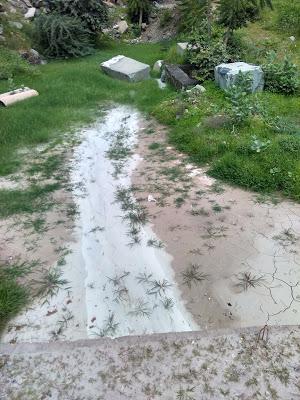
In this photos, we can see the white colored element in water, the local people call it salary, it's the dominant reason for the declining productivity of the farms and destruction of the crops. In rains, it comes from mines to farms and it destroys crops.


The Mines owner dumped its mine waste on the grazing land which was the primary sources of grass for the village people, but as due to heavy dumping the grassland has destroyed so it badly affected the livestock of the village, now only a few people have livestock. It affected people economically, due to this they lose their income as well as now they are dependent on others for basic things like milk.


The condition of the transport system in the village is very poor, there is no bus service for people, they have to wait for 2 to 3 hours for private vehicles. the roads are in very miserable condition. due to overloaded trucks, people face problems. in case of emergency, its become more difficult.


In this village, people have a canal, but it is not that useful as the white water from mines comes in the canal and it pollutes water so therefore it's not useful for the people.


The mines also affected the children in the village, mostly it affected their education and health, as their fathers are working in mines and having less payment while mothers mostly don't have any job to do, many children are facing the issue of malnutrition. In schools, most of the students think that they don't need to study hard as they don't have any scope of studying after completing 12th so they just complete 12th and starts working in mines. So it creates a vicious circle of poverty and people are from generations trapped in this circle.

Labour Epistemology: Reflections from the Mines of Rajasthan


Labour Epistemology is a precise attempt for discovering the realities and hardships faced by mine workers in Rajasthan. The attempt is directed towards locating the epistemic foundation of labour studies in the context of mineworkers. Meanwhile, it is very crucial for this epistemology to develop new knowledge forms which would be emancipatory in nature. The scope of such emancipatory knowledge will ultimately benefit the working class for developing policies and enhancing governance framework. Since a majority (more than 80 per cent) of mineworkers is constituted by the social categories of Dalits and Tribes. In relation to the social categories engaged in the mines, the role of perspectives or logic of inquiry becomes very essential. Therefore the Perspective from Below and Perspective from Within becomes has a greater role in generating the new knowledge forms.
For developing such an epistemology, it is very crucial to look over the fundamental tenets and tools applied in the field. before going to the field the field worker/ researcher should change its location of viewpoints and try hard to apply the tenets of Dalit and Tribal Social work. In which, the vision, mission and goal must have a clarity in all senses. The standpoint of working ‘with’ has a special role in this. This standpoint not only ‘empowers’ the target community and people but also led a greater exploration of the student/ researcher in the field. Although from the part of field worker it is crucial to play the role of a mediator between the disempowered and the authorities, rather than becoming ‘the voice’ of the population. Reflections made from the field should be critical and exploratory in nature. along with this, the field worker should take the responsibility of becoming an agent of change which not only brings changes in themselves but also empower the community to bring changes by themselves.
The author was placed in Udaipur for the fieldwork with the objective of carrying out case studies which were based on checking the effectiveness of DMFT (District Mineral Foundation) District Mineral Foundation (DMF) is a trust set up as a non-profit body, in those districts affected by the mining works, to work for the interest and benefit of persons and areas affected by mining-related operations. It is funded through the contributions from mine owners – private or government. In case of all mining leases executed before 12th January 2015 (the date on which MMDR Amendment Act came into force), miners will have to contribute an amount equal to 30% of the royalty payable by them to the DMFs.  Where mining leases are granted after 12.01.2015, the rate of contribution would be 10% of the royalty payable (Subsequent to the enactment of MMDR Amendment Act, mining leases are given out after auctions; hence, a lower levy).
Exploring the Impact of Mines on Mineworkers and Nearby Areas
In its simplest version, mineworkers are those individuals who perform their skills in mines for their livelihood and survival. Mineworkers are supposed to work to excavate mineral and other resources from the earth crust. In general, there are two types of mines one is open mines and the second is closed/underground mines. The author has engaged with the workers of marble mines which is open in nature. There is always a danger to work in the mines but the degree of risks or mishappening in open mines is very less than that of closed mines. But on the other hand, the risks in open mines like that of marble mines are very dangerous and a single small piece of a stone may act as a bullet. Apart from it, mine workers have to work in depth of more than 300 feet which sometimes creates casualties. The processing of marbles is also one of the aspects of where the problems of mineworkers are embedded. The processing involves blasting which not only invites shaking of the crust but also produces a gas cloud which is very polluted in nature. The gas coming out of mines due to blasting not only inhaled by the workers but also by the people residing in the nearby area which ultimately creates breathing related disorder. after the process, the hill is cut into big blocks which are further get divided into blocks. for making the blocks the workers are required to drill the big blocks by marking. the process of drilling also creates dust which is directly/indirectly inhaled by the mineworkers. Sometimes the required equipment like masks, helmet, gloves and gumboot are provided but the quality of that equipment is somehow not good. Although in the case of a drier region like Jodhpur the dust engulfs the region and people residing in the nearby area of mines. In some cases, it was breathing related disorder was also found with the people not going to mines like that of children and women. In this, scenario diseases like silicosis become a ‘common’ injurious disease for the mine workers and that of people directly/indirectly affected by the mines.
The day to day life of the people in nearby areas has affected deeply. Mines have affected people’s lives in terms of livelihood, agriculture, water, environment, livestock, health, and education. Agriculture in most of the affected area is either stopped or the production has lowered due to changed and degraded soil quality. Since most of the mines in rural areas a negative impact on agriculture have costs loses in terms of livelihood and make harder for the farmers to rear the livestock they were keeping from a longer period of time.  
Examining the Issues of Mineworkers
When it comes to deal with the issues of workers as a class, wage becomes the central concept on which the major debate occurs. From minimum wage to living wage thousands of study has been carried out on dealing with this issue. With the arrival of private ownership in mines, the wage has become a central point of discussion, along with the job insecurity and unavailability of social security measures. From the field experience, it was heavily noted that most of the private enterprises are handing over their mines through tenders. By distributing their mines to the tenders the real owners not only get rid of regulations and handling the issues related to workers but they started earning money without putting their effort. Under the tender system, mineworkers are getting exploited heavily. They have to work for 12 hours with the payable amount of minimum wage defined by the state government, the working conditions and its regulatory situation is not taken care off, in case of any injury or death no fixed compensation is made (the case is more severe in case of migrant workers), and there is delocalisation of labour. Apart from it, alcohol consumption and domestic violence have become very common for mine workers. In justification many mine workers have blamed the workload for these things and said that ‘this (liquor) has become part of life without it we can’t do anything’.
In between that the mines under the tender system are not made to set up labour unions and this is one of the most crucial factors which is very much hindering the labour rights. In some cases, it was complained by many of the mine workers that most of the leaders of labour unions are under the pockets of mine owners, because whenever any demand is raised the leaders get lured by money or other forms of assets. Meanwhile, it was also observed that there was a clear political-industrial nexus in the case of marble mines. In fact, many of the mines were owned by local politicians. It was informed by a number of mine workers that no government regulation is followed in mines and whenever any checking occurs, the visiting officers are bribed with lakhs of rupees.
Capturing People’s Intentionality for Change (on Utilisation of DMFT amount)
It was very interesting to see the aspects on which the people wanted to change, the prospects of changes were not only limited to personal benefits but also for the overall development of the community. Most of the persons with whom the author got the opportunity to engage demanded a sustainable mining with minimisation of harms. Along with this, most of them demanded proper utilisation of DMFT money taking the interests of villagers at the centre of drafting any project. Along with this, there was a hugely demanding of localised labour use in mining and the creation of alternative livelihoods for the people. Meanwhile, there was a sense that was coming out in the form of ‘old is gold’ which directly refers to the destruction and negative impacts of mines over the Indigenous peoples. A positive upliftment in the localised sense was the crux of major demands made by the people.
Problematics of Marble Mines: Reflecting from an Indigenous Epistemological Point
During fieldwork, the author got an opportunity to work with the indigenous peoples of Rishabhdev Block of Udaipur district which comes under the Tribal Sub Plan (TSP) region.  The tribal group among whom the author got the opportunity to work with was Meena community. Mines (embedded with the European modernity) in those areas impacted the area in a broader way of socio-economic and cultural way of life as well as destroyed their epistemological growth. Most of the people with whom the authored interviewed were quite clear about their history but the current practices were not very grounded. People were quite aware of the value of forest, land but the connection with the forest was missing. This point was linked with the absence of any practices with was centred upon the forest and sacredness in their life. In the era prior to 60s people were having common (non-Brahmanical) festivals but as the process of Hinduisation started with the glorification of Maharana Pratap they were made to believe that they are Rajputs. Even their god (Keshariya Ji) was cleverly theft/merged by the Gujarati upper caste Jains (who were partners of the mine owners) and renamed as Rishabhdev (The first Tirthankar of Jains). The story behind this theft was mainly based upon the earnings of the temple. People were aware of their earlier kingdoms but among the youths, this is somehow missing. The geographical intervention done by marble mines have severely destructed the forest, filled the grazing land with dumps, occupied the common land and forest meanwhile the ‘leftover’ forests were declared reserved by the state government. In this situation, people were compelled to work in mines and as the technology enhances in the mines people started moving to other places for the same jobs. The phenomenon of migration has become common and the state education system has limited the indigenous learning in the younger generation. Although there is some kind of tribal assertion and their histories is tried to be written by some organisation but on an epistemological level, they are facing a huge pile of problems by coming under the Brahmanical fold. Their epistemological condition was directly realised by the author while home visits where many of houses were painted with lion and tiger but none of the members of those houses were able to explain the meaning of that and in justification, they said it is part of our tradition.
Summing Up
Mines as a part of producing primary resources for industries have a greater contribution to our economy, which not only provides a heavy amount of revenue but also provide livelihood to lakhs of people. But one should not generalise this only by looking the revenue/income criteria that mines are benefitting people. The dilution in labour laws along with the booming tender system in the mines has increased the problems of the mine workers significantly. One should look over the problems of workers engaged in it and not ignore the hardships faced by the people residing around it. The issues and problems should be dealt with deliberation and policymaking. In a similar fashion, DMFT was an outcome of various struggles and movement by the civil society, especially the labour centred organisation. The team of social worker which was sent for conducting research was given the objective of checking the effectiveness of DMFT on the ground and how much things have changed in mines and the lives of people affected directly or indirectly by the mines. By going through the data and conversation one can easily trace the adverse impacts of mines on the people and in a nutshell, DMFT has failed to provide a grounded solution to people’s population. Although it will be a mistake to judge a government policy after three years of its implementation the working style of the trust is still questionable. Most of the members of the trust are officers and there is least participation is provided to the representative of people/ mine workers. In some cases, representatives from labour unions are being provided to speak up but at the end, things remain whatever the powerful members want. I am saying this because very few people (none of the mineworkers) were aware of this policy and those who know it had complained about its shortcomings.  


Women and Mining.


In almost all societies Male holds Primary power and dominates political leadership, controls property, Moral and social Authority and Privilege. During my fieldwork in massaron ki obri I came in contact with so many people who are directly or indirectly affected by mines, so during this time, I came to know about various issues faced by women in the village.
In every economic sector, women face discrimination and Mines sector is one of the most discriminated places to work for women. As mine work is linked as heavy work and women are seen as weak and therefore they don’t get a job in mines same as a man, women get work like breaking grit and get paid very less than the males. There are very few women working in mines, others are working in farms or having livestock and spending their time on them. As mines have its effects on the environment, farms productivity is reduced so agriculture is not that productive now, and as grassland has been destroyed by mine’s owner by dumping waste on it so now women are losing livelihood on livestock. It affected all the families of the village as almost half of the population of the village became jobless and they don’t have any option of livelihood. They don’t get a job in mines, and now their traditional occupation of agriculture and livestock is also destroyed by the mines.
The issue is not just limited to livelihood, but it’s an issue of survival as the life expectancy of the mine work is very low, there are many widows in the village, they don't have livelihood as well as they don't get any kind of government schemes like widow pension, when they go to apply for the pension, the official don't consider their application, and also this women are not that educated they face many issues in documentation.
In this kind of situation to live as a woman is too difficult, still the level of education in girl child is not improving in the village, many parents don’t send their daughters to school as there is no separate school or separate classroom facility for girls.